MEEG 302
COMPUTER ASSIGNMENT 2
DUE: 5 P.M.- MAY 5, 1999
A common annoyance in cars in winter months is the formation of fog
on the glass surfaces which blocks the view. A practical way of solving
this problem is to blow hot air or attach electrical resistance heaters
to the inner surfaces. Consider the rear window of a car that consists
of 0.4 m thick glass (k = 0.84 W/mK and a
= 0.39 ´ 10-6 m2/s).
Strip heater wires of negligible thickness are attached to the inner surface
of the glass, 4 cm apart. Each wire generates heat at a rate of 10 W/m
length. Initially the entire car, including the windows, is at the outdoor
temperature of T0 = -3° C. The
heat transfer coefficients at the inner and outer surfaces of the glass
can be taken to be hi = 6 W/m2K and ho
= 20 W/m2K.
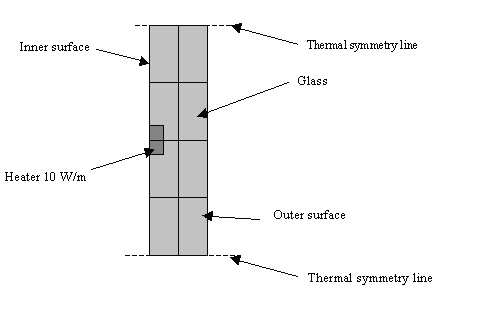
Using the explicit finite difference method with a mesh size of Dx
= 0.2 cm along the thickness and Dy =
1 cm in the direction normal to the heater wires, determine the temperature
distribution throughout the glass 15 minutes after the strip heaters are
turned on. Also, determine the temperature distribution when steady-state
conditions are reached.
Notes:
-
For a description of the explicit and implicit methods refer to pages 248-263
of the textbook. Table 5.2 on p. 252 lists the stability criteria
for various node configurations. You need to take these criteria into account
when choosing a time step Dt. Your time step
needs to be chosen so that the Fourier number Fo (as defined by
eq. 5.72 on p.249) satisifies all of the stability criteria, i.e.
at the interior, side and corner nodes. If even one of these stability
criteria is not satisfied, the solution will diverge.
-
When you submit your project, please include:
-
all equations used along with any heat balance diagrams (10% of your grade)
-
clearly labeled plots with at least 10 contour levels (20%)
-
a hardcopy of your code; if you use the built-in formulas in Excel then
a copy of the representative equations as you typed them in (10%)
-
brief comments about the temperature distribution and its main features
(10%)
The remaining 50% is automatically awarded if you make a reasonable
attempt at the solution.
Don’t include:
-
the numbers on your Excel spreadsheet
-
your files on disk
-
Remember one thing: this project is different from the first project because
it is a time dependent problem instead of a steady state one. In
the first project, the iterations represented better and better approximations
to the steady state solution; in this project, the iterations represent
actual temperature distributions at different times. You will need to use
substantially different code for this project; instead of a loop which
terminates when convergence is reached you need to march forwards in time.
You may work with the same team member or switch or go solo. Please list
the contribution of each team member